This morning, while waiting for my school children to arrive at class, I did something I haven't done in a couple of years. I wrote a song. It's a shame the inspiration had to be something so tragic, but something urged me to put some words on paper. At the time of this post, I have not put music to the words yet, but the sentiment is there I believe.
"A Song for Boston, 2013"
words by C.A. Willimon
In a crisp New England Spring, like so many days before,
The city of Boston lay in wait for what's in store.
In the town of Hopkinton, over twenty-six miles away,
Nearly thirty thousand athletes prepared to start their day.
It was a day of celebration, of patriots, of pride,
Of runners chasing dreams with half a million on their side.
Just over four hours later, at the Boylston celebration.
Tragedy struck Boston at the height of their elation.
Boston, oh Boston,
May you see no more harm.
For those who had fallen,
You opened up your arms
Boston, oh Boston,
May you see no more harm.
Amid the chaos at the finish, no one knew just what to think.
As a frightened, worried nation, we watched as our hearts sank.
The scene was hard to take but no one could look away.
Our prayers went to Boston; we were New Englanders that day.
One could not help but notice, despite the dangers there,
There were many risking their own lives just to give aid and care.
Some of us have fallen; many lives are changed forever,
But Boston's care for all our friends is what we will remember.
Boston, oh Boston,
May you see no more harm.
For those who had fallen,
You opened up your arms
Boston, oh Boston,
May you see no more harm.
Tuesday, April 16, 2013

Thursday, April 11, 2013
Pride and Pain: Umstead 100
 |
| Pain is a gift. |
Ambitious, stubborn, crazy...these are all things I've been called in the past few months. And, they are all necessary qualities of a successful ultra runner. I needed all of them this past weekend at the Umstead 100 Mile Endurance Run. I was crazy to sign up for Umstead, stubborn to follow through with the training, and ambitious to set a lofty first-time goal of completing the distance in 24 hours (and earning a coveted silver "One Day" finisher's belt buckle). However, as race director Blake Norwood stated at the Friday evening pre-race briefing, the long months of training and hard work would get me to the starting line, but will would get me to the finish.
 |
| Ambitions, stubborn, and crazy. |
The Course:
The Umstead Endurance Run course consists of a certified 12.5 mile lollipop loop with an out-and-back thrown in after the first half mile of rocky gravel road. The Airport Spur out-and-back section (comprising about 2 total miles) is the flattest and least exciting part of the course, and late in the race, it is a deceivingly mentally difficult stretch. After passing by the gate that lead to and from the start/finish, one begins the loop proper. On the Reedy Creek bridle trail, there are 3 miles of long, rolling hills--including an especially long uphill after passing a scenic lake overlook. Following a left turn, there are a couple miles of shorter rollers before a couple of sharp drops leading into Aid Station 2, where the bridle trail parallels Ebeneezer Church Rd. After AS2, one gets a flat quarter mile to eat some food or send a text message before cutting left into the infamous "Sawtooth 79" section. "Sawthooth," because the elevation profile goes up and down like, well, sawteeth; and "79" because it goes from mile marker 7 to a bit past mile marker 9. So after those steep climbs and jarring downhills, one climbs to a left turn onto Graylyn bridle trail, and the longest sustained downhill of the course (my favorite). It's referred to as the "Power Line" section because the hill S-curves around a large power line in a clearing. Then it's a half-mile climb before a right turn on Reedy Creek, which takes one back from whence he or she came, sans Airport Spur. On that last 1.5 miles, there are a couple of stinky climbs, including Cemetery Hill, which is well known by veterans of Umstead 100 and Umstead Marathon alike. Right turn at the gate, charge into start/finish/AS1, and repeat 7 more times. Got it? Good.
 |
| The excitement of Camp Lapihio just before the start. |
The Race:
We started at 6am, about an hour before dawn. I settled in with what I though were the front-of-the-middle-packers. The pace, while slow for any other foot race, seemed a bit quick to me for the start of a 100 miler, so I let folks pass me by and kept pace with the majority of those around me. I settled in with DARTer Jeff McGonnell (who has run 5 Umsteads and dozens of 100s) and his close friends, Daniel and Steven Pieroni. We shared several miles together during the first lap, even though I had to drop and catch up with them a few times while I was dealing with some early GI and over-hydration issues. We had gone 4 or 5 miles before Jeff realized exactly how fast we were going, which was too fast. Eventually, we backed off and settled into a groove before hitting AS2. I dropped off my cotton gloves and head lamp and filled a plastic bag with a 1/4 PBJ sandwich, some pretzel sticks, and a small boiled potato. I had been eating gels, but I was determined to mix in real food early on. This particular combination would serve me well for 50+ miles to come. The Sawtooth was a bit cool, but the varied terrain was not unwelcome. I rocked the power line hill and hiked up the last few hills before heading into HQ/AS1 and finishing my first lap in 2:04:xx. Considering my initial stomach issues, I was happy with this initial pace.
Lap 2 was a thing of beauty. I had a pace dialed in, and my GI issues were under control, so I just focused on sticking to the plan and enjoying the run. It was still early on, so there was no fatigue or discomfort yet. I ate according to my pre-ordained schedule, walked according to the terrain and perceived effort, and relished the company of my fellow runners. I even ran a few more miles with Steven Pieroni, who was not running as fast as me, but would make up for it by out-walking me. At AS2, I spent a total of 15 seconds. Without stopping, I just scooped the food I wanted into my zip-lock bag as I walked by. I waited until the first real uphill on the Sawtooth to eat most of it. While I continued to play to the terrain, I saw many runners stubbornly running every hill. I would catch up to them or leave them behind on the next flat or downhill, so I let them do their thing. Many of them I would not see again after lap 3 or 4. After climbing Graylyn and turning inbound on Reedy Creek, I really enjoyed the multitude of runners going each direction. There certainly was a big sense of camaraderie in this race. Lap 2 was a 2:06, almost an even split with lap 1. To boot, my wife Heidi was waiting at HQ to greet me and snap a photo or two.
 |
| Coming in strong and feeling good at 25 miles. |
Lap 3 was a bit of a lull. I knew I was planning on a progressively slower pace from here on out, but the warming temperatures of the late morning and mid day were starting to make their presence known. Many of the non-walkers from before were walking now. I was glad I had started walking early. I ate okay, but I was going through water a lot more quickly and voiding it not nearly as often. Lap 3 was 2:21:xx, and it felt a lot harder than it should have. Heidi was there and told me I still looked good, so I took her word for it. I wasn't looking forward to lap 4, but I tried to keep a positive mental outlook. "12.5 more miles, and I will at least be allowed a pacer," was my reasoning. I originally intended on finishing the first 50 miles in 9 hours (by 3pm), but to do that, I would need to run a 2:29 lap 4. There was no need to push it, as my quads already were starting to hurt. So, I ran lap 4 very similarly to lap 3, but I took a couple more walk breaks and relaxed my pace a little. I finished 50 miles in 9:10:58, which was a 50 mile PR by over two hours! Heidi was there, but so was the rest of my crew: Phyllis Tsang and Chad Randolph. At least I would have company for the rest of the race.
 |
| Halfway there! It was pretty hot out by this time. |
I told Phyllis and Chad that I was still able to run the downhills hard, run/walk the flats, and walk all of the uphills, but from here on out, I was going to walk when I felt like it, run while I could, and let the chips fall as they may. Phyllis joined me for lap 5, and the terminally dull Airport Spur seemed to go by rather quickly thanks to her conversation. I walked a lot more on this lap, but I still threw in some running spells on the flats in order to keep the cumulative pace respectable. Phyllis was surprised at how hard I was willing to run the downhills this far in the race. "No wonder your quads hurt," she told me after the first few bomber descents. Much of the field had taken a more conservative approach to the downhills, and they often would part like the Red Sea to the edge of the trail when they heard us charging downward from above like Stuka dive-bombers. My lap with Phyllis was just under 3 hours--a pace with which I was very content. Qualitatively, other than the aches and pains of 62.5 cumulative miles, lap 5 was almost as enjoyable as lap 2. The total race time by the end of the lap was just under 12 hours and 11 minutes, and since I had never raced a 100K before, I decided to take it as my 100K PR. Two PR's so far this race, and I wasn't even finished!
 |
| Phyllis and me after completing lap 5. 100K down! |
At HQ/AS1, I finally retired my sweat-soaked Reckless Running singlet and put on a dry shirt. The sun was getting low in the sky, and my pace would continue to slow, so I didn't want to get caught with wet clothes when the temperature dropped. Phyllis decided to stay at HQ to volunteer and hang out for the rest of the race, but Chad had agreed to run (er...walk) the final three laps with me. Lap 6 was a slow and steady walk, with very little level-terrain running of which to speak. We still ran the downhills, and they continued to hurt, but I found that if I opened up and ran a bit faster, my stride would reach a sweet spot where everything hurt less. I could maintain it for a long descent, but only if I knew there was a nice, walkable uphill afterwards for recovery. That's the beauty of the Umstead course. By the end of the 6th lap, it was fully dark outside and I was wearing three layers. 75 miles down, a little less than a marathon to go...
 |
| Chad and me on the dreaded Airport Spur. |
From here on out, I was content to walk every section of the course that was not downhill. I also was not worried about lingering in the aid stations. Both of these things brought my overall pace to a crawl. I had been experiencing emotional and physical ups and downs for most of the day, but around mile 77 was the first time I truly had doubts about finishing. I had been hurting--really hurting--for many hours, and I was starting to feel not only physically tired, but sleepy as well. This is where the flat monotany of the Airport Spur really began to take its toll on me. I voiced my doubts to Chad and implied that I seriously was considering dropping out. His response was almost nonchalant:
"Nah, you're doing great. It's an ebb and flow. You feel like s***, then you feel great, then you feel like s***. You're still moving forward. You'll finish in one day...or you won't; who cares? I know you'll finish, just like Jeff will finish. Heck, we got until noon."
That's pretty much all I needed to hear. I don't remember much of that part of the evening, but those few sentences of casually comforting words stuck with me. I picked up the walking pace a little. A couple miles later, we came upon an unmanned water station that had a veritable myriad of cookies from which to choose. I gobbled down three or four and felt better almost instantly. In retrospect, low blood sugar probably had a lot to do with my earlier bout of despair. I packed some cookies in my plastic to-go baggie and we were on our way.
The rest of lap 7 and most of lap 8 passed by in much the same order over the long, dark hours of Saturday night and Sunday morning. Even my walking pace had slowed down, but I still ran the downhills, gritting my teeth and exhaling loudly. Chad kept the conversation going, and while I wasn't my usually chipper self, my relative outlook was rather positive. There were no more instances where I doubted I would finish. As the miles and the hours ticked by, Chad and I repeatedly calculated what pace I would need to maintain in order to achieve a sub-24 hour finish. Very gradually, we were banking time. The realization began to sink in that not only would I be a finisher, but I would be a single-day finisher. After bidding a final adieu to the Sawtooth, we took off down the Power Line hill for the last bit of sustained running. Hike up Graylyn, turn right, one last climb up Cemetery, walk it in, Chas, walk it in. I even walked down the last little downhill just so I could muster up the energy to run up the last 20 meter hill to the finish line. Boom. 23 hours, 36 minutes, and 5 seconds. One-day finisher, silver buckle, and three PR's in one race. I nearly cried as I was handed my buckle, but I think I was too tired.
 |
| The picture may be blurry, but so was I. |
Done. In every sense of the word, I was done. My body, somehow knowing the race was over, decided to shut down directly. Chad and Phyllis guided me back into the HQ at Camp Lapihio where Jonathan Savage gave me a congratulatory embrace, and he lead me to a warm spot by the hearth before hypothermia set in. I very deliberately stripped off my wet layers and replaced them with dry sweats, marveling at the swollen clubs that once had been my feet. I had a protein shake in my hand, but for some reason, I had no idea what to do with it. Phyllis ran me some hot soup and a couple slices of pizza, and that hit the spot. As I ate, I took in the grim scene around me. Runners were strewn about on cots and benches in various states of slumber. Others had bandages covering both feet. Still others were hunched over with head in hands, looking very unhappy. As much as I was hurting, I thought I was a little better for wear than many of these folks. Then I tried to stand. Bad idea. It was hard to believe that not 15 minutes earlier, I had been running. There was no horizontal space left to lie down and nap, so I sat up and leaned. 5 minutes...30 minutes...I still don't know how long I was sitting there zoning out. I was in a lot of pain, but as a sign three miles from the finish said, "Pain is temporary. Pride is Forever."
 |
| Well said. |
The Gear:
Shoes: Hoka Stinson Tarmacs. For me, these shoes have one purpose: long, hilly ultras. They did not disappoint. Naturally, my feet hurt anyway, but I don't think any amount of cushioning is going to prevent that after 100 miles. I did get one nasty blister on my left pinky toe, but I'm not sure if it's from the shoes, my socks, or just Umstead. Also, I had been developing a hot spot on my right first metatarsal over the past couple of months, and I began to feel it the morning of the race, so ten minutes before the gun, I borrowed Blake Norwood's pocket knife and cut open a slot in the upper to relieve the pressure. Problem solved.
Socks: Injinji Original weight with Balega Hidden comfort on top. Inov-8 Debris Gaiters.
Shorts: RaceReady Compression. Pockets and comfort. Period.
Singlet: Reckless Running Cyan Swarm. Lightweight and comfortable, perfect for when the day warmed up.
Hydration: I switched back and forth between a Nathan Minimist Hydration backpack with a Hydropak bladder and a 20oz Ultimate Direction handheld.
Nutrition: No fewer than 20 gels, no fewer than a dozen 1/4 PBJs, several boiled potatoes with salt, dozens of pretzel sticks, 4-5 cups of soup, 2 cups of coffee, about 20 cookies, and no ginger. I was able to eat without getting nauseated for the duration.
 |
| AS1 at mile 25. Eating was not much of a problem. |
Many thanks go to my wife for supporting me throughout the long months of training, and to my pacers: Chad and Phyllis. Anyone wanting to attempt the 100 mile distance, Umstead is the place to do it. The people there do it right!
Wednesday, February 13, 2013
Shoe Reviews: Racing Flats
Okay, so since I have been racing so much, most of my blogging has been about racing or training for races. However, in an effort to make this running blog about more than just competition (and since I will be racing less between now and Umstead), I plan on doing some reviews and comparisons of the large selection of running shoes that have made it onto my feet. Since I have a rather large shoe closet, these reviews will come in installments by category, beginning with racing flats. I have used all of the shoes in this post (with the exception of the Adios) in multiple races, and I intend to provide objective, anecdotal responses based on my own personal running style. Therefore, my cheers or jeers need not be taken as factual testaments to the quality (or lack thereof) of any of these products...unless you and I are very like-minded. Further disclosure: In no way do I officially endorse any of these models or the manufacturers that produce them. I purchased these shoes myself, except in one or two cases where the shoes were a gift from family or friends; none of these shoes were comped by their respective manufacturers. Point of order: while all of these shoes are intended as racing shoes, I use most of them for more than just racing, and one or two may in fact fit the role of daily trainer for me in particular. Okay, my disclaimer is finished. Now, off to the road-burners!

Adidas Adizero Adios 2
The Adios is the heaviest, most built-up underfoot shoe in this list. That being said, at under 8 ounces for my size 9.5, it's still much lighter than most daily trainers. I originally intended this shoe to be a marathon racer, and I considered donning it for the recent Charlotte 50k, but I opted for the trusted Green Silence, which I will describe below. The Adios is very firm considering the amount of EVA foam and the 9mm heel-toe drop, but firmness is a trait of many Adidas shoes. While a firm response is a desirable trait in a racing flat, I think the Adios is a bit too for racing long distances. I have a feeling my feet would be pretty beat up after 26.2 or 31.1 miles in these babies. The outsole is very durable and and tracks well on roads and non-technical trails. The upper is a bit constrictive around the lateral edge of the toe-box, and the hard heel cup gives the Adios a slightly back-heavy feel in my opinion. The shoe is a good trainer, and it has performed well on long intervals and intermediate steady-state workouts, but I'm not so sure it will move into that marathon racing niche for which it is intended.

Adidas Adizero Hagio
Like its big brother, the Adios, the Hagio is a firm racing flat with excellent traction on roads and non-technical trails, but the similarities end there. At just over 6 ounces for a size 9.5, the Hagio is racer light but still has just enough material to be durable. The toe-box is ample, and the 6mm offset in the heel is very conducive to an efficient foot strike with some added protection of medium-long races run at near maximal effort. I have PR'd a 15k in these shoes, but I think they would perform well at a Half Marathon or 30k length race while still being lithe enough to be a solid 5k racer. They are among the most versatile racing flats in this list. My only gripe with the Hagio is the short laces' tendency towards coming untied. After a 6 mile training run where I re-tied (and double knotted) my laces three times, I replaced them with elastic speed laces and have since ran with impunity in these shoes. The Hagio is a common choice for my track work as well.

Brooks Green Silence
The Green Silence (which is slated for discontinuation by Brooks this year) will always have a special place in my heart. This is the marathon racer in which I qualified for Boston for the first (and hopefully not the only) time. Looking at the shoe in the box or on a display wall, one first notices the burrito-like one-piece upper that folds over itself, and the substantial midsole made from Brooks' BioMogo EVA foam. The shoe is surprisingly light for its appearance (just over 7 ounces for my size 9.5), and has more heel drop that I usually care for. The Green Silence is the most comfortable shoe on this list, with the soft mesh hugging the foot due to the fold-over tongue construction. Walking around in the GS, the cushion feels very soft and mushy for a racing flat, but at marathon paces and above, the shoe responds well to a well-planted mid foot strike. This shoe can go the distance without slowing me down or being too firm to beat up my feet. After marauding down the mountain at Ridge To Bridge in the GS, my legs were trashed, but my feet felt great. I will continue to use the GS for marathons and Road 50k's until I wear it out and fail to find anymore size 9.5's left in the world. As a bonus, the GS is completely biodegradable when tossed in an active landfill. Karma points.

Inov-8 Bare-X Lite 150
While I do a lot of training in zero-drop shoes, the Bare-X Lite 150 is the only zero-drop flat I race in regularly. I have several pairs of Inov-8 shoes, and they all seem to fit their own specific niche. The 150 (which stands for 150 grams/US size 9, which is my Inov-8 size) is pretty much a race-day only shoe. In order to save weight, the 150 uses a one-piece, tongue-less upper with minimal overlays, an integrated speed-lacing system, and no rubber outsole. The thin midsole is blended with denser foam to make up for the lack of blown rubber, but the result is still a low-mileage lifespan. I have put maybe 50 miles on my 150s and they shoe considerable wear, with barely any outsole detail remaining on the lateral side of the mid foot. The optimal race distance for the 150 is 5k, although I did set my current 8k PR in this shoe at the Leprechaun Loop 8k. I also used these for my only (as of yet) 1-mile time trial, in which I ran an uncertified 5:27. Also, because of its slipper-like fit and quick on/off, this would be a great go-to for triathletes at Sprint and possibly Olympic-length events.

Inov-8 Road-X Lite 155
The 155 is a road racing demon in bright yellow. It's weight and materials are similar to its zero-drop cousin, but it has a more conventional tongue and lace design, a slight 3mm heel lift, and a flatter outsole surface that seems to provide more longevity for the light fusion outsole material. The shoe is very light (5.5 ounces), extremely flexible, and has a very comfortable toe-box. All in all, it is a very fun shoe in which to run or race. I have set a few fast 10k times in this shoe, including my current PR, but it also served me well at the hilly Charity Chase Half Marathon. I would not feel comfortable racing with this shoe in anything other than dry or nearly dry asphalt, but that clearly is its intended role.

New Balance MRC1600
The 1600 is one of New Balances new racing flats, and it is advertised at a lightweight choice that is suitable for racing up to marathon distance. For its sub-6 ounce weight, the 1600 has a decent amount of RevLite EVA foam in the midsole, and the grip pattern on the outsole gives it a fair amount of traction. The upper, which consists of soft, thin mesh with many strategic overlays, is comfortable for a racing flat, although the toe-box is a little pointy. My 9.5 is very comfy, but it leaves room up front so as not to fit totally snug like my flats do. If I were to size down to 9.0, I would achieve snugginess, but then I would be crowding my 4rth and 5th toes like I would with the Adios. Also, after racing Richmond Marathon in this shoe, I find its marathon worthiness dubious. For me, the optimal distance for this shoe is 13.1. In fact, I raced my current Half Marathon PR in the 1600 this past New Year's Eve at Freedom Park. Aside from racing, I do many mile-repeats and other road intervals in the 1600.

New Balance MRC5000
This not only is my lightest racing flat, but it is the lightest shoe I have ever worn, and that includes sandals! At 3.1 ounces for my size 9, the 5000 is considerably lighter than the box in which it comes. It uses the same RevLite material as the 1600, but much less of it, and the thin mesh upper lacks the overlays of its marathon-touting sibling. The nothing-but-mesh upper hugs my foot nicely, and the cushion and traction are surprisingly smooth and reassuring for a shoe that's too light to even serve as a paperweight. One cannot help but run fast in these flats. My third run in them was the Huntersville Holiday 5k, which was a decisive PR. The 5000, as its designation may imply, is a go-to speed racer for 5k's, but I believe it would hold its own at a 10k, and it certainly would be good weapon for 1-mile races, 3ks, or anything in the "shorter" road race category.
There are many varieties of racing flat on the market now, and I would welcome any readers' thoughts and/or reviews of the models listed or any other road flats that I have not had a chance to sample. Among the list I would like to hear about are the ASICS Gel-Hyperspeed, the new ASICS Blazingfast, Brooks T7, Mizuno Wave Universe 4 (or upcoming 5), Newton MV2, and Saucony A5. Of course, I have read several praising reviews of these go-fast shoes from various sponsored sources, but any private and objective remarks are welcome comments to this blog.

Adidas Adizero Adios 2
The Adios is the heaviest, most built-up underfoot shoe in this list. That being said, at under 8 ounces for my size 9.5, it's still much lighter than most daily trainers. I originally intended this shoe to be a marathon racer, and I considered donning it for the recent Charlotte 50k, but I opted for the trusted Green Silence, which I will describe below. The Adios is very firm considering the amount of EVA foam and the 9mm heel-toe drop, but firmness is a trait of many Adidas shoes. While a firm response is a desirable trait in a racing flat, I think the Adios is a bit too for racing long distances. I have a feeling my feet would be pretty beat up after 26.2 or 31.1 miles in these babies. The outsole is very durable and and tracks well on roads and non-technical trails. The upper is a bit constrictive around the lateral edge of the toe-box, and the hard heel cup gives the Adios a slightly back-heavy feel in my opinion. The shoe is a good trainer, and it has performed well on long intervals and intermediate steady-state workouts, but I'm not so sure it will move into that marathon racing niche for which it is intended.

Adidas Adizero Hagio
Like its big brother, the Adios, the Hagio is a firm racing flat with excellent traction on roads and non-technical trails, but the similarities end there. At just over 6 ounces for a size 9.5, the Hagio is racer light but still has just enough material to be durable. The toe-box is ample, and the 6mm offset in the heel is very conducive to an efficient foot strike with some added protection of medium-long races run at near maximal effort. I have PR'd a 15k in these shoes, but I think they would perform well at a Half Marathon or 30k length race while still being lithe enough to be a solid 5k racer. They are among the most versatile racing flats in this list. My only gripe with the Hagio is the short laces' tendency towards coming untied. After a 6 mile training run where I re-tied (and double knotted) my laces three times, I replaced them with elastic speed laces and have since ran with impunity in these shoes. The Hagio is a common choice for my track work as well.
Brooks Green Silence
The Green Silence (which is slated for discontinuation by Brooks this year) will always have a special place in my heart. This is the marathon racer in which I qualified for Boston for the first (and hopefully not the only) time. Looking at the shoe in the box or on a display wall, one first notices the burrito-like one-piece upper that folds over itself, and the substantial midsole made from Brooks' BioMogo EVA foam. The shoe is surprisingly light for its appearance (just over 7 ounces for my size 9.5), and has more heel drop that I usually care for. The Green Silence is the most comfortable shoe on this list, with the soft mesh hugging the foot due to the fold-over tongue construction. Walking around in the GS, the cushion feels very soft and mushy for a racing flat, but at marathon paces and above, the shoe responds well to a well-planted mid foot strike. This shoe can go the distance without slowing me down or being too firm to beat up my feet. After marauding down the mountain at Ridge To Bridge in the GS, my legs were trashed, but my feet felt great. I will continue to use the GS for marathons and Road 50k's until I wear it out and fail to find anymore size 9.5's left in the world. As a bonus, the GS is completely biodegradable when tossed in an active landfill. Karma points.
Inov-8 Bare-X Lite 150
While I do a lot of training in zero-drop shoes, the Bare-X Lite 150 is the only zero-drop flat I race in regularly. I have several pairs of Inov-8 shoes, and they all seem to fit their own specific niche. The 150 (which stands for 150 grams/US size 9, which is my Inov-8 size) is pretty much a race-day only shoe. In order to save weight, the 150 uses a one-piece, tongue-less upper with minimal overlays, an integrated speed-lacing system, and no rubber outsole. The thin midsole is blended with denser foam to make up for the lack of blown rubber, but the result is still a low-mileage lifespan. I have put maybe 50 miles on my 150s and they shoe considerable wear, with barely any outsole detail remaining on the lateral side of the mid foot. The optimal race distance for the 150 is 5k, although I did set my current 8k PR in this shoe at the Leprechaun Loop 8k. I also used these for my only (as of yet) 1-mile time trial, in which I ran an uncertified 5:27. Also, because of its slipper-like fit and quick on/off, this would be a great go-to for triathletes at Sprint and possibly Olympic-length events.
Inov-8 Road-X Lite 155
The 155 is a road racing demon in bright yellow. It's weight and materials are similar to its zero-drop cousin, but it has a more conventional tongue and lace design, a slight 3mm heel lift, and a flatter outsole surface that seems to provide more longevity for the light fusion outsole material. The shoe is very light (5.5 ounces), extremely flexible, and has a very comfortable toe-box. All in all, it is a very fun shoe in which to run or race. I have set a few fast 10k times in this shoe, including my current PR, but it also served me well at the hilly Charity Chase Half Marathon. I would not feel comfortable racing with this shoe in anything other than dry or nearly dry asphalt, but that clearly is its intended role.
New Balance MRC1600
The 1600 is one of New Balances new racing flats, and it is advertised at a lightweight choice that is suitable for racing up to marathon distance. For its sub-6 ounce weight, the 1600 has a decent amount of RevLite EVA foam in the midsole, and the grip pattern on the outsole gives it a fair amount of traction. The upper, which consists of soft, thin mesh with many strategic overlays, is comfortable for a racing flat, although the toe-box is a little pointy. My 9.5 is very comfy, but it leaves room up front so as not to fit totally snug like my flats do. If I were to size down to 9.0, I would achieve snugginess, but then I would be crowding my 4rth and 5th toes like I would with the Adios. Also, after racing Richmond Marathon in this shoe, I find its marathon worthiness dubious. For me, the optimal distance for this shoe is 13.1. In fact, I raced my current Half Marathon PR in the 1600 this past New Year's Eve at Freedom Park. Aside from racing, I do many mile-repeats and other road intervals in the 1600.
New Balance MRC5000
This not only is my lightest racing flat, but it is the lightest shoe I have ever worn, and that includes sandals! At 3.1 ounces for my size 9, the 5000 is considerably lighter than the box in which it comes. It uses the same RevLite material as the 1600, but much less of it, and the thin mesh upper lacks the overlays of its marathon-touting sibling. The nothing-but-mesh upper hugs my foot nicely, and the cushion and traction are surprisingly smooth and reassuring for a shoe that's too light to even serve as a paperweight. One cannot help but run fast in these flats. My third run in them was the Huntersville Holiday 5k, which was a decisive PR. The 5000, as its designation may imply, is a go-to speed racer for 5k's, but I believe it would hold its own at a 10k, and it certainly would be good weapon for 1-mile races, 3ks, or anything in the "shorter" road race category.
There are many varieties of racing flat on the market now, and I would welcome any readers' thoughts and/or reviews of the models listed or any other road flats that I have not had a chance to sample. Among the list I would like to hear about are the ASICS Gel-Hyperspeed, the new ASICS Blazingfast, Brooks T7, Mizuno Wave Universe 4 (or upcoming 5), Newton MV2, and Saucony A5. Of course, I have read several praising reviews of these go-fast shoes from various sponsored sources, but any private and objective remarks are welcome comments to this blog.
Friday, February 8, 2013
Do you Run Reckless?

I'm very excited to announce that I now am an official brand ambassador for Reckless Running! If you have seen me at a race in the last 8 months or so, odds are you have seen me in a Reckless Running singlet. I'm pumped to represent the homegrown company and share how awesome their athletic apparel line is AND how much they do to better the sport of running. To those who are reading this, you get to take advantage of this opportunity. Go to the Reckless Running online store and enter the discount code "CHAS" (case sensitive) in the appropriate field during the checkout process in order to receive 15% off of your order (not counting sale items or shipping). You can use this code whenever you visit the store. Now get out there, support our local brand and what they do, and Run Reckless!
 |
| Me with Bobby Aswell at NYE Half. I'm wearing the Coat of Arms singlet. |
 |
| Sporting the Gray Fray singlet at the Charlotte Ultra Run. |
 |
| Me with fellow DARTer Jeremy Alsop, both wearing the Royal Blue RR racing singlet |
 |
| Hoodie and tapered warm-up pants (with ankle zippers) by RR. |
From the About Us section of the RR homepage:
Anthony Famiglietti, a 2-time Olympian and 6-time US Champion, co-founded Reckless Running with the hopes of changing his sport for the better. Our dream for this brand is to set an example of self reliance and set the stage for many young and older runners alike to follow their dreams.
Our brand is all about runners supporting other runners. Our clothes help you perform and your dollars help us live out our dreams. And hopefully we will inspire you to greatness along the way.
Our brand is all about runners supporting other runners. Our clothes help you perform and your dollars help us live out our dreams. And hopefully we will inspire you to greatness along the way.
The Reckless Running logo was created to encapsulate and symbolize the philosophy of the brand. The name relates to the logo since we embrace the concept of running with pure reckless abandon. The idea is to abandon fear, trepidation, self doubt, fatigue, lack of focus or anything else that limits individuals from reaching their full potential. The goal is to run free of any pre-disposed limitations set upon us in life either metaphorical or tangible and overcome all barriers we may face with ease.
RR stands out among the sea of sameness in running. We hope you do the same and stand with us to change the sport for the better in the 21st century.
RR stands out among the sea of sameness in running. We hope you do the same and stand with us to change the sport for the better in the 21st century.
Monday, February 4, 2013
Recap of Charlotte Ultra Run 50k
2013 has been a busy year so far. It's 35 days into the new year and I have logged well over 300 miles of running, including two 50k's and a 13-mile trail race. The last of these--the Charlotte Ultra Run 50k (CUR)--was two days ago. I had to give myself a little time to think about this race in hindsight. I learned a lot about myself as a runner from this race, and from the weeks leading up to it.
Exactly four weeks prior to CUR, I ran a very successful (according to my goals at the time) Frosty 50k at Salem Lake. Logic, and most training plans would have it that I take three to four weeks to recover before resuming my regular training, or at least set up a modest recovery/taper pyramid if I had another upcoming race, as I did in the form of CUR. I did neither of these things. Instead, I ran my regular pace and mileage beginning the day after Frosty and resumed 20 and 30 mile runs the very next weekend. Part of it was the fact that CUR was not a focus race, and that my real focus was keeping my training volume high for Umstead without interuptions from a taper/recovery cycle. I also wanted to experiment a bit and see what I could do without a taper...ya know, to see if all this ultra marathon training was making me tougher, weaker, or some functional combination of the two.
With the early February weather placing the starting tempurature in the mid-twenties, I was glad the race HQ was at a Montessori school with a heated gymnasium. I was also glad to have picked up all my new Reckless Running race gear and warm up clothes from Fam and Karen the night before. Fam even lent me his RR arm warmers.
CUR took place on Mallard Creek Greenway. The course consisted of five out-and-back laps with a double turn-around spur near the 5k mark. There also was a 10k race option that consisted of a single out-and-back on the course. The pancake-flat course was built for speed. 40% of the surface was unpaved dirt road with some gravel, and the rest was smoothly paved asphalt. There was water and food at the start/finish and the turn-around, as well as an additional water station about halfway down the path, so we were never more than 1.5 miles from water or aid. In addition, medical personel were patroling the course on four-wheelers throughout the race. One could get pampered at a race like this.
As with Frosty, I carried my own water and nutrition and resolved not to waste any time at the aid stations. When the race began, a handful of people shot out ahead, most of whom I assumed were 10k'ers. I fell in with a conversational group including last year's female champion Meg Hovis, Bill Shires (who was pacing Meg for much of the race), Jamaar Valentine, and ultra-running guru Jonathan Savage. Savage could dust most of us if he wanted, but he had raced the mountainous Sultan 50k the previous week and logged over 100 miles of training runs in the brief interim. He was on another level altogether, although I figured his cumulative training stress might give me a chance to keep him in check. Soon enough, I realized I was getting caught up in the social front-running pack and establishing too quick of a pace. I had to force myself to back off. Jamaar and Savage did the same not long after me, because I caught up to them before we completed the first 10k.
It was easy to get into a rhythm on this course because of its predictability, but this would prove to be a double-edged sword; I was too comfortable running too fast. In fact, I ran much of the first half at a sub-7:20 pace. I ate and hydrated at regular intervals and just let the miles pass by. A couple of regretable restroom stops ate up a few minutes, but I was still on pace for a sub-4 hour 50k, which I guess was my goal. February 2nd was an appropriate day for this race, because the repetative out-and-backs gave me a Groundhog Day kind of feel. At 35k, I started to feel the fatigue coming on, and I tried to adjust my pace accordingly, but I could tell I was going to reep what I had sewn.
At the start/finish turn-around (40k), I was happy to hear a couple of familiar voices. Heidi, my wife, was there to cheer me on, as was fellow ultra-running DARTer Chad Randolph. With the race clock at 3:11:xx, I muttered that a sub-4 finish was going to be very hard as I passed by Chad. 10k at slightly sub-8 minute miles doesn't sound too hard unless you already have a hard 25 miles on your legs, which I did. When I got to the 42k mark--which is about as close to a marathon split as the course markings had--I checked my time. 3:20:xx, about the same as my marathon split four weeks earlier at Frosty, but I was feeling a lot more broken down this time. I think it was here that I started bargaining with myself, which is when paces start to spiral downhill. I gritted my teeth through two more 8-minute miles and resolved to make it to the 5k mark (45k cumulative) before I walked. 90 seconds later, I started running again, but my 8-minute miles were over. When I came to the 4k out mark, Savage ran by me, still on his outbound leg. That meant he had 6k to go, and I had 4k. Okay, at least I can keep Savage at bay. Easy does it. In those last 2 1/2 miles, I threw in two more one-minute walk breaks, but I would rather slog the last couple of miles and come across the finish line strong than drag myself across with a glazed-over facade for want of keeping up a plodding jog.
I finished with an official time of 4:03:27, about 200 seconds slower than my goal. But, I finished in the top ten (9th overall, 8th male), which was another informal goal. Savage finished about five minutes later, still with an impressive 4:09:xx. The man is a machine.
So what have I learned? I learned I can be competitive at a fast 50k even in the midst of over-training, so I'm tougher than I thought...though still not as tough as Jonathan Savage...not even close. I also have been thinking about this competitive monkey on my back I've been feeding for the past few months. I've raced A LOT. If I could channel that competitive energy into just training for Umstead, then I can stop worrying so much about running 100 miles and just know that it's there for me to take.
Exactly four weeks prior to CUR, I ran a very successful (according to my goals at the time) Frosty 50k at Salem Lake. Logic, and most training plans would have it that I take three to four weeks to recover before resuming my regular training, or at least set up a modest recovery/taper pyramid if I had another upcoming race, as I did in the form of CUR. I did neither of these things. Instead, I ran my regular pace and mileage beginning the day after Frosty and resumed 20 and 30 mile runs the very next weekend. Part of it was the fact that CUR was not a focus race, and that my real focus was keeping my training volume high for Umstead without interuptions from a taper/recovery cycle. I also wanted to experiment a bit and see what I could do without a taper...ya know, to see if all this ultra marathon training was making me tougher, weaker, or some functional combination of the two.
With the early February weather placing the starting tempurature in the mid-twenties, I was glad the race HQ was at a Montessori school with a heated gymnasium. I was also glad to have picked up all my new Reckless Running race gear and warm up clothes from Fam and Karen the night before. Fam even lent me his RR arm warmers.
 |
| Keeping warm before the start. |
As with Frosty, I carried my own water and nutrition and resolved not to waste any time at the aid stations. When the race began, a handful of people shot out ahead, most of whom I assumed were 10k'ers. I fell in with a conversational group including last year's female champion Meg Hovis, Bill Shires (who was pacing Meg for much of the race), Jamaar Valentine, and ultra-running guru Jonathan Savage. Savage could dust most of us if he wanted, but he had raced the mountainous Sultan 50k the previous week and logged over 100 miles of training runs in the brief interim. He was on another level altogether, although I figured his cumulative training stress might give me a chance to keep him in check. Soon enough, I realized I was getting caught up in the social front-running pack and establishing too quick of a pace. I had to force myself to back off. Jamaar and Savage did the same not long after me, because I caught up to them before we completed the first 10k.
 |
| One more lap to go... |
At the start/finish turn-around (40k), I was happy to hear a couple of familiar voices. Heidi, my wife, was there to cheer me on, as was fellow ultra-running DARTer Chad Randolph. With the race clock at 3:11:xx, I muttered that a sub-4 finish was going to be very hard as I passed by Chad. 10k at slightly sub-8 minute miles doesn't sound too hard unless you already have a hard 25 miles on your legs, which I did. When I got to the 42k mark--which is about as close to a marathon split as the course markings had--I checked my time. 3:20:xx, about the same as my marathon split four weeks earlier at Frosty, but I was feeling a lot more broken down this time. I think it was here that I started bargaining with myself, which is when paces start to spiral downhill. I gritted my teeth through two more 8-minute miles and resolved to make it to the 5k mark (45k cumulative) before I walked. 90 seconds later, I started running again, but my 8-minute miles were over. When I came to the 4k out mark, Savage ran by me, still on his outbound leg. That meant he had 6k to go, and I had 4k. Okay, at least I can keep Savage at bay. Easy does it. In those last 2 1/2 miles, I threw in two more one-minute walk breaks, but I would rather slog the last couple of miles and come across the finish line strong than drag myself across with a glazed-over facade for want of keeping up a plodding jog.
 |
| A bit battered, but finished. |
So what have I learned? I learned I can be competitive at a fast 50k even in the midst of over-training, so I'm tougher than I thought...though still not as tough as Jonathan Savage...not even close. I also have been thinking about this competitive monkey on my back I've been feeding for the past few months. I've raced A LOT. If I could channel that competitive energy into just training for Umstead, then I can stop worrying so much about running 100 miles and just know that it's there for me to take.
Sunday, January 6, 2013
Salem Lake Frosty 50k 2013: a Recap.
Author's note: for some reason, I am unable to upload photos on this blog currently. To read this recap with photos, go here.
My goal for this year’s Frosty 50k was to beat 4 hours. More specifically, I was trying to take an
hour off my previous 50k PR (4:57:59) which was set at the same race last
year. A 4 hour 50k calls for a 7:43 minute/mile
pace over the course of 31.1 miles.
Given my average marathon pace for the most recent couple of 26.2’s was
in the low-7’s, I figured the pace would not be the problem. Not bonking on the last few miles was my main
concern.
With the Frosty races (50k, 25k, and 50k relay options)
being so close to home, many of my running friends often make it out to get in
a nice ultra to start the year, or try their hand—er, feet—at tackling the
ultra distance for the very first time, much as I did last year. So it was a very social event, albeit
freezing at the start. Running the 25k
were Dave Munger, Chris Joakim, John Richards, and Garry Fee. Running the relay were Allen Strickland,
Laura Gray, Chris Lamperski, and one of their running friends. Running the 50k were veteran marathoner Bobby
Aswell, Katie and Jason Rose (who met each other at this race two years
earlier), veteran ultra-runners David Moore and Chad Randolph, ultra-newbies
Kara Vincent and Johane Hirshfield (both of whom Chad was pacing), Mike Vance,
and Emily Hansen, who had been running a heck of a season already with several
marathons and halves within just a few months.
Bobby had hoped to run a 4:00-4:05 today, so we informally planned to
run together. Dave, who was out to get a
good run in but not necessarily race all out, figured he would run at about our
pace as well.
It was very cold at the start, hovering around freezing with
some cool air coming off of the lake. I
was ready with my layers. I did some
pre-hab drills with my running jacket on and shed it atop my drop bag a few
minutes before the start. We would not
feel the cold for very long. At the
start, it took almost no time to settle into my mid-7’s pace. My tapered legs felt great, and the
pre-ordained race pace was about the same as my regular easy-run training pace
as of late, so I took off on auto-pilot for the first few miles. Bobby locked in with me, and Dave gradually
pulled ahead. Four hours is a long time when viewing it from the start of the race, so I just focused on setting a routine. Cut the tangents, keep drinking water, and eat a gel every 22 minutes. Since I was carrying my own water, I breezed through all of the aid stations, and Bobby only slowed down briefly to grab water cups on the go, so we maintained a 7:30 pace +/- 5 seconds for the entire first leg (12.5k, 7.75mi). Our split at the first leg was 58:11, nearly two minutes faster than a 4-hour pace. We maintained the same, consistent pace throughout the rest of the first half, save for a slightly slower mile 9 due to a switchbacked climb on the greenway. After passing through the Linville Road aid station at the far eastern side of the lake, I spied Dave ahead and within reach. He evidently had backed off of his low-7’s pace from the first few miles. We caught up with Dave at about mile 13, and he confirmed that it was taking some time for him to feel 100% after a recent running hiatus.
I pushed ahead (with Bobby not far behind) in order to bank a little time for a brief transition at the halfway point, which was the Start/Finish area for all of the races. The race clock showed 1:56 and change for the first 25k, so I had banked a good bit of time. I ran through the chute and immediately bee-lined for the facilities, after which I shed my gear vest and tech shirt, grabbed a fresh bottle from my drop bag, and hit the trail for round two. The race clock read exactly 2 hours as I started the second half. There goes all the banked time…
Bobby had continued on ahead while I made my stop, so I was accountable for my own pace now. The third leg went by much the same as the first, with continued even splits, and more ground made up on those ahead of me. With the 25k racers coming in to finish, the field ahead of me began to thin out. At about the 21-mile mark, I saw the 50k leader on his final inbound leg. With only about 6 miles to go, and looking as good as he was, I reckoned he was on his way to a potential course record. [Edit: Ethan Coffey did in fact set a new course record with a smoking time of 3:00:10!] He was dozens of minutes ahead of the next 50k racer. At the final turnaround, I saw that I was no longer that far behind Bobby. Allen, whose team had just handed off the baton to anchorman Lamperski, cheered us on, and then more subtly urged me to catch Bobby! We’ll see…
Starting my final leg, I cruised along the greenway keeping Bobby in sight, and gaining inches on him here and there. Dave was near the spillway at the 22/24 mile mark to cheer us on. Bobby was 100 feet ahead of me. “I’ll catch him,” I informed Dave. Climbing the switchbacked hill on the greenway, I made my way up to Bobby, and we ran a couple more miles together as before. At five miles from the finish, I glanced at my watch. So far I had run a marathon distance in 3:20 and still had gas in the tank. I figured that anything faster than 8 minute miles at this point was money in the bank. Nearing the last aid station at Linville Road (3.5 miles out), I started to pull away once more. I was feeling a bit worn down from 3 ½ hours of hard running, but I wasn’t bonking. Whenever I spotted Bobby across the fingers of the lake trail, I cheered him on. I passed a few more 50k’ers in the final few miles and low-geared my way up the final hill. From there, the last mile was an exercise in maintaining pace and finishing strong. I ran the last 200 at full stride and finished with a gun time of 3:56:43. Goal accomplished.
Bobby came in shortly after with a 3:58:11, also ahead of his goal. At the time I am writing this recap, the official results are yet to be posted online, but I’m fairly certain that both Bobby and I made the top ten finishers for 50k, and Bobby’s time is likely in the top three for course records in the grand masters’ division. [Edit: According to the results, I was 7th overall and Bobby was 8th overall among 156 50k racers.]
Shortly after Dave snapped some photos for us, I started to get hypothermic, so I layered up and started drinking hot chicken broth, which did the trick. I stuck around to cheer on all the other DART finishers, especially Kara and Johane, who were now officially ultra-marathoners, and Katie Rose, who set a 15+ minute PR with a sub-4:25 50k. It was a great day at Salem Lake. Now I have a respectable 50k PR to try and break next month at the Charlotte Ultra-Run.
What worked:
Shoes: La Sportiva Vertical K: Low profile, and great
traction and surprising cushion for a lightweight trail shoe.
Socks: Smartwool full-length compression with Balega crew
layered over. This worked at the NYE
Half five days earlier, so I went with the same formula to repeated success.Race clothing/layers: RaceReady compression shorts with pockets full of gels, Reckless Running Singlet, Umstead Marathon tech shirt, Manzella ear warmers, cotton gloves with chemical hand-warmers inside, Nathan arm warmers, and Nathan HPL 28 gear vest, also full of gels. I ditched the tech shirt, chem hand-warmers, and the Nathan vest at the half.
Hand-held hydration: I carried an Ultimate Direction 20oz
handheld water bottle so I could breeze by the aid stations without stopping
and take gels whenever I needed. I had a
second bottle in my drop bag so I could switch out at the half and not have to
worry about refilling.
Nutrition: I’m fairly confident that I carb-loaded
appropriately for this race, but what likely made the difference was the 10
gels I consumed at regular 22 minute intervals throughout the entire run. Honestly, I’m surprised I did not get
sick. I went with a mix of Clif and GU,
with about half of the gels being caffeinated.
Tuesday, January 1, 2013
Freedom Park New Years Eve Half: Round and Round...
Happy New Year, everyone! I capped off 2012 with a bang. As I said in my last post, my goal for 12/31 was to break 90 minutes for Half Marathon at Freedom Park New Years Half-Marathon. Everything went down more or less according to plan. Well a little bit faster than planned.
In planning my race strategy, I knew I would be running roughly 13.3 laps of the Freedom Park Greenway, so my intended 6:40 pace would translate to a 6:34 for one full lap (1:59 for the first 0.3). Here are my actual splits:
Lap time (Lap Pace according to Garmin*)
1:50 (6:11)
6:30 (6:32)
6:30 (6:32)
6:29 (6:31)
6:30 (6:33)
6:34 (6:37)
6:40 (6:41)
6:36 (6:39)
6:32 (6:32)
6:28 (6:31)
6:30 (6:32)
6:34 (6:34)
6:34 (6:34)
6:16 (6:16)
*My Garmin recorded all of the laps as 0.99 or 1.00 miles, but the certified distance for each lap is 0.98 miles, so the average 6:32 pace in inaccurate. According to the certified course measurements, my average pace for 13.1 would have been 6:36, which still is faster than I ran at Lungstrong 15k.
Running fast on a lap style course was an exercise in cutting tangents. There were a handful of S-curves along the greenway, and hugging the tangents allowed me to run a fairly straight line through them much of the time. Also, there were a couple of very modest hills along the course, but climbing each of them 13 times at race pace got old after a while.
It was great to see fellow DURT team members Stan Austin and Bobby Aswell, Jr. at the event. Stan ran the Full option (3:39:xx) and Bobby ran the Half with me (1:33:xx). Also present was Richard Heffner, who ran a 1:38:58 for the Half, only 3 seconds behind his time from the previous year. Running the 24-Hour ultra were a couple of familiar elite ultra-running faces, namely Anne Riddle Lunblad (last year's winner with 140+ miles) and Jonathan Savage. My time of 1:26:37, aside from being a massive 5-minute PR, was good enough for 3rd place overall in the Half. This earned me a hearty handshake from RD David Lee. Like all of Lee Timing's events, the volunteers were wonderful and the spread for the participants was fantastic. I'd like to come back next year and try my hand...er...feet at the 24-hour option. Now on to Frosty 50k!
What worked:
Shoes: New Balance MRC1600. While not protective enough for 26.2, these shoes did prove to be great 13.1 racers.
Layers: I wore two pairs of socks (ironic for the Sockless Runner), and I had two long-sleeve tech shirts and a pair of arm sleeves on over my singlet. It was cold! By the end of the race, I was down to my singlet. That's the advantage of a lap style race: you can leave your clothes wherever!
By the way, here is my Garmin data for the race.
In planning my race strategy, I knew I would be running roughly 13.3 laps of the Freedom Park Greenway, so my intended 6:40 pace would translate to a 6:34 for one full lap (1:59 for the first 0.3). Here are my actual splits:
Lap time (Lap Pace according to Garmin*)
1:50 (6:11)
6:30 (6:32)
6:30 (6:32)
6:29 (6:31)
6:30 (6:33)
6:34 (6:37)
6:40 (6:41)
6:36 (6:39)
6:32 (6:32)
6:28 (6:31)
6:30 (6:32)
6:34 (6:34)
6:34 (6:34)
6:16 (6:16)
*My Garmin recorded all of the laps as 0.99 or 1.00 miles, but the certified distance for each lap is 0.98 miles, so the average 6:32 pace in inaccurate. According to the certified course measurements, my average pace for 13.1 would have been 6:36, which still is faster than I ran at Lungstrong 15k.
Running fast on a lap style course was an exercise in cutting tangents. There were a handful of S-curves along the greenway, and hugging the tangents allowed me to run a fairly straight line through them much of the time. Also, there were a couple of very modest hills along the course, but climbing each of them 13 times at race pace got old after a while.
 |
| Start. |
 |
| Finish. |
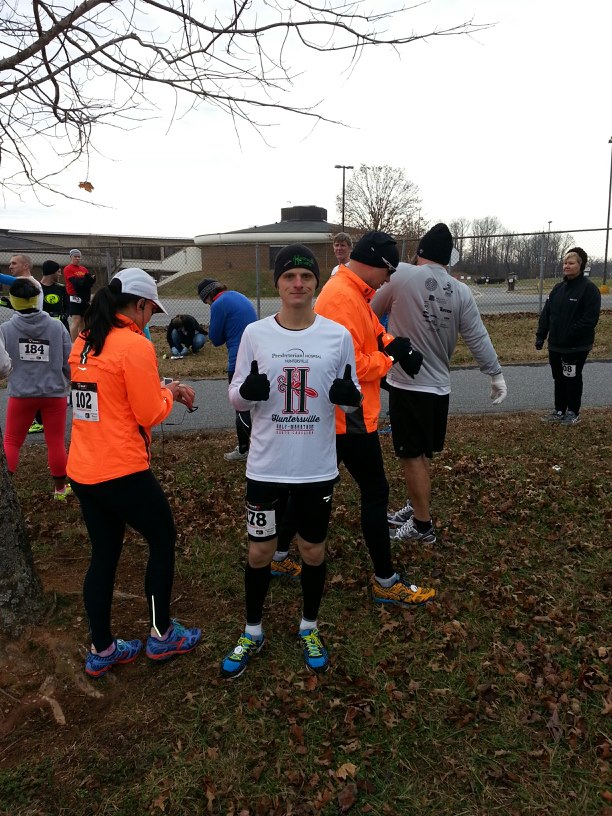
It was great to see fellow DURT team members Stan Austin and Bobby Aswell, Jr. at the event. Stan ran the Full option (3:39:xx) and Bobby ran the Half with me (1:33:xx). Also present was Richard Heffner, who ran a 1:38:58 for the Half, only 3 seconds behind his time from the previous year. Running the 24-Hour ultra were a couple of familiar elite ultra-running faces, namely Anne Riddle Lunblad (last year's winner with 140+ miles) and Jonathan Savage. My time of 1:26:37, aside from being a massive 5-minute PR, was good enough for 3rd place overall in the Half. This earned me a hearty handshake from RD David Lee. Like all of Lee Timing's events, the volunteers were wonderful and the spread for the participants was fantastic. I'd like to come back next year and try my hand...er...feet at the 24-hour option. Now on to Frosty 50k!
What worked:
Shoes: New Balance MRC1600. While not protective enough for 26.2, these shoes did prove to be great 13.1 racers.
Layers: I wore two pairs of socks (ironic for the Sockless Runner), and I had two long-sleeve tech shirts and a pair of arm sleeves on over my singlet. It was cold! By the end of the race, I was down to my singlet. That's the advantage of a lap style race: you can leave your clothes wherever!
By the way, here is my Garmin data for the race.
Subscribe to:
Posts (Atom)